Saturday, April 27, 2013

Tips for Attending a Homeschool Curriculum Fair

I went to a a large curriculum fair today, for the second time in my life. Here are a few tips I have learned, some from others, some the hard way.

If possible, preview the vendors and a map online before the event. Have at least a general idea of items your family will need in the upcoming months and years. Spend some time reviewing the vendor list and familiarizing yourself with their products. Spend a little time looking online at prices so you can recognize a good bargain when you see one.

Bring a friend (or two). It's nice to have someone to chat with on the drive. It's nice to have a sounding board for ideas, or a second opinion. It's nice to have a second pair of eyes looking for that one item you cannot miss. I like to leave the kids at home.

Bring pre-printed mailing labels with your name and address on them. It's nice to have these to stick on forms for mailing lists, instead of writing out all your information over and over.

Know your budget. Bring some cash. If you use a debit card, and you are traveling to the fair, give your bank a call so they don't freeze your card for suspicious activity. Bring a backup credit card or checkbook.

Bring a tote bag or backpack, or rolling crate. You will need something in which to carry all your purchases. If possible, carry some outside to the car sporadically.

Always peruse the used book stalls and ask vendors about scratch and dent books. Ask about bundling. Haggle. Those folks want to carry home as little as possible.

If you can't get what you want at the fair, ask about any deals for ordering at the fair. You may get a hefty discount, or free shipping.

Take your time and have fun!


Thursday, April 25, 2013

Portfolio Review Preparation

Here's a quick post about how I prepare portfolios for our county homeschool review.

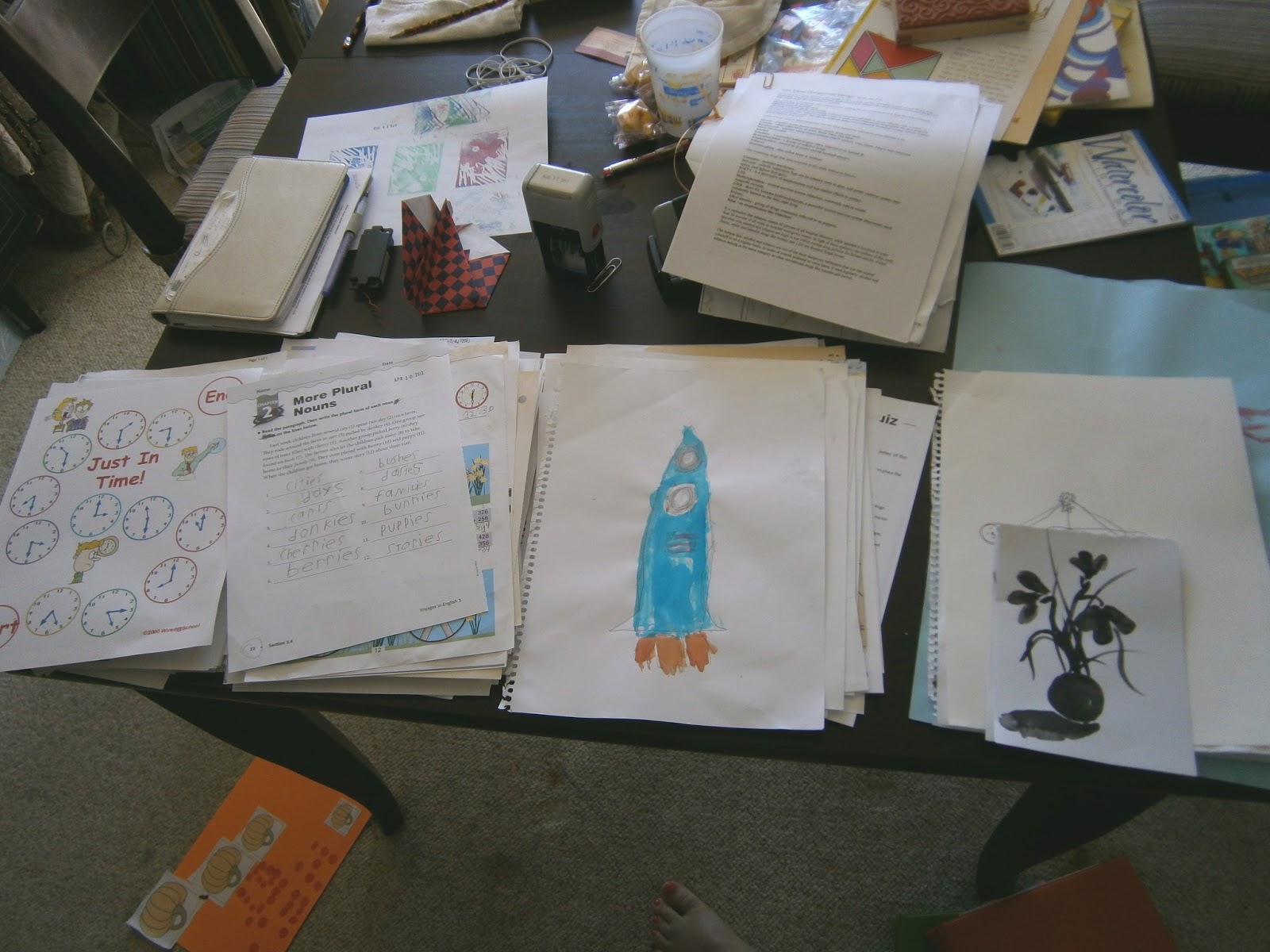
About two to four times per month, I sit down with a stack of papers like this.


My first step is to sort the papers by child.
I end up with five stacks: one for each child, one of school printouts that will not go into portfolios, one of weird miscellaneous stuff that doesn't belong with school papers at all, and recyclables.

For the next phase, I grab my planner, date stamp or pen, hole puncher, and a pair of scissors.

Sometimes, my kids don't date stamp their work. The planner is helpful to remind myself what we were doing on what dates.  The scissors are for cutting off this stuff.


I take out anything that cannot be hole-punched and put in the binder.

Doesn't this stack look much more manageable already?

These odd sized things go in the front pocket of the binder.

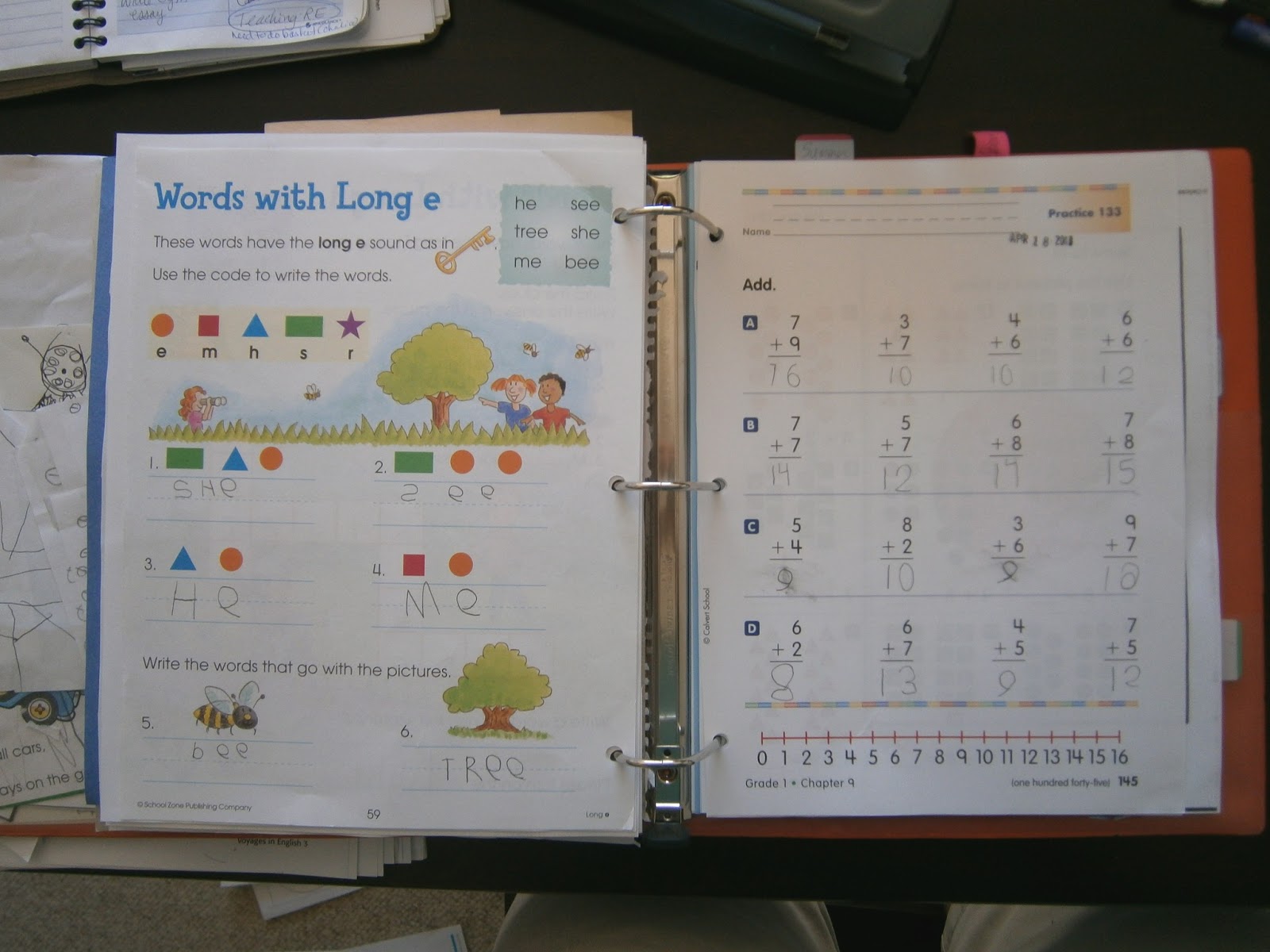
After everything has been date stamped, I start adding things to the binder, in chronological order. I include an example per week from each subject. If the subject isn't obvious, I make a note on the top of the page.

I add photos by pasting them onto computer paper, adding a caption or date if appropriate, and add it to the binder.
I like to include photographs of our workspace, classes outside our home, social time, art projects that don't fit in our portfolio, our garden, travel, and pictures of the boys doing some of their work.

Anything that doesn't go in the binder goes into the large paper portfolio. I have one for each child. This is  also where any oversized projects get stored.
Repeat for next child!

I hope this helps someone else keep all this paperwork organized!

Monday, April 8, 2013

Teaching Time

Thing One (9) has a tough time with analog clocks. They are counter-intuitive to him. He thinks the long hand should be used for the hour hand instead of the minute hand. Here are some activities I put together to try to reinforce his memorizing the rules and trying to make it fun.

Draw a huge clock outside with sidewalk chalk. Or on a dry erase board or chalkboard. Have your child hold a short stick for the hour hand and a long stick for the minute hand. You call out a time and they move their arms into the correct position.


Play this fun computer game: stop the clock.

Try time flashcards. My set has analog on one side and digital on the other. Thing Two (6) can read the digital side, too, so he can help Thing One practice.

We have found one of these to be very helpful.  I love that the minutes are marked around the edges.

Here's an online one.  analog clock


Opera Unit Study

Here is an idea of the Opera unit study I have put together for my kids. We do music together despite the difference in age (K and 3rd grade).

Bantam of the Opera by Mary Jane Auch-a cute picture book about a rooster with a passion for fine music.
The Dog who Sang at the Opera by Jim West and Marshall Izen

Phantom of the Opera Musical by Andrew Lloyd Webber
coloring page of Andrew Lloyd Webber

Die Walkure (The Valkyrie) by Eichard Wagner
Valkyrie coloring pages

Hansel and Gretel by Englebert Humperdinck
Read the fairy tale by the Brothers Grimm
or listen to the Golden Book version on you tube: http://www.youtube.com/watch?v=UoWfkuiTMs8
Metropolitan Opera Educator Guide 

Little Red Riding Hood by Seymour Barab
Watch the Golden Book version on you tube: http://www.youtube.com/watch?v=5CkCpx3CE2Q

Metropolitan Opera videos on demand
http://www.metoperafamily.org/ondemand/catalog/index.aspx
You can "rent" a video for 30 days, or do a free 7 day trial. I think this would be an amazing tool to watch different versions of a production, and compare sets, costumes, and performances.

There are quite a few opera for kids CDs out there as well. Try your local library.


Design your own opera online game: http://www.classicalkusc.org/kids/opera/index.asp
This is an extremely well done interactive game which lets the students try out various roles from the production of an opera, like lighting, choreography, costume, and props.


Monday, August 27, 2012

Planner Porn

I'm sharing my innermost homeschool planning secrets today. Here's what is working for me right now.

My everyday planner. This handles the general overview of my life, including anything not school related.

It's a super simple At A Glance Collegiate Planner. I like that I can see the entire week at a time, it's small enough to fit in my handbag, and it's cheap.

This is my main homeschool planner, in a binder. I made a list of contents to remind myself what's inside.

My color coded daily schedule. It's different for each child. Managers of their Homes helped me learn how to schedule my school day effectively. I copied this schedule and posted it on our wall for easy reference. The kids like to look at it, too, and often keep me on schedule.

Each school month has a tab. Behind each tab is a two-page monthly calendar spread. 

Under each monthly tab, there are weekly planning sheets for my older son. Facing each weekly sheet is a family planning sheet.
I don't remember where on the intertubes I found this sheet, but it has been immensely helpful.

This is my weekly planning sheet. Across the top are days of the week, down the left side are school subjects. I pencil them in and check them off as we complete them.

I also keep a list here of things I need to remember. It's the first page so it's the first thing I see when I open my planner binder.

The next binder is for my kindergartner. The first page is a checklist I made to make sure I have work in his portfolio for each week of the school year.

This is a list of all his unit study topics by week.

Each unit study topic has a tabbed cover sheet. This is where I list my goals for the study, and what supplies we will use, what field trips we will go on, what books we will read, what art projects we will do, etc. If  I have printouts (workbook sheets, art project ideas) for the unit study, they go behind each tabbed cover sheet.

My next binder is where I keep all my ideas, resources, and worksheets for my third grader. It has a tab for each subject and things are filed behind each tab.
In social studies, I have a cover sheet for each geography lesson, where I list topics, supplies needed, and ideas.


Each child has a daily folder where I put worksheets they are to finish. This is also handy for taking with us. The vinyl zipper pocket holds pencils, rulers, scissors, glue stick and anything else they might need while we are schooling away from home (or if I just send the third grader to the desk upstairs to work independently).
When they finish their sheets, they place them back in the folder, and I check them when I have time. They go from here to porfolio binders.

Each child has a (color coded) portfolio binder. I put these together before the school year starts, so that as work is completed, I can fill it up and it will be ready to go to our portfolio review. First page is attendance.

This is where I keep logs for each child. I have a log for everything. Reading, field trips, movies and educational tv, scouts, physical education, music, carschooling. I find keeping up with this stuff is hard, so the only way I can do it is if I take a minute at the end of each day to write down what we did. My evening routine is to check worksheets from the daily folders, fill in our logs, journal a bit if necessary, check off attendance and portfolio checklists, then prep for the next day. I do a lot of weekly prep on Sunday evenings if I can do it in advance.

And lastly, I keep a binder of blank forms. Any kind of form that I think I might use on a regular basis I keep here. I keep originals of all my planning sheets in here.

So it seems overwhelming, but it's six binders (two medium, four large) and two folders. It fits easily on my school supply shelf with our text books and it's working for me right now!

New Year, New Setup

I'm always fascinated to read about and see what other families do for their school environment. We had a schoolroom for a few years, until our boys decided they just could not share a room anymore, and for the sake of family harmony, we moved the younger son into his own room and gave up the classroom. Our dining room is now our classroom, although we do some work in different spaces in our home, like the sofa, living room floor, upstairs desk, on the bed with a lapdesk, in the car, waiting at the doctor's office, outside,...

Here is our dining room setup. Lots of maps on the walls for our geography study.

View from the kitchen. Cozy reading chair with a corner shelf is a favorite spot.

On top of the upright piano: bins for art supplies, music supplies, everyday office supplies (scissors, glue, date stamp, sticky notes, stapler), construction paper.

All of our books, notebooks, planners and manipulatives (that we are currently using) are on these four shelves. I have a lot in storage in various places in the house that we are not currently using. Library books have a designated shelf in the living room.
Baskets on the shelf hold all our smallish things like math manipulatives, geography passports and stickers. Containers are such an easy way to keep things neat, separated, and easy to grab.
Our daily schedule is posted on the wall for easy reference.

Sunday, August 26, 2012

Mean Girls Movie Review

I know this movie came out years ago (8 years ago, in fact), but I just got around to seeing Mean Girls for the first time last night. I was into my craft project and it came on tv, and  even though it's not my usual sort of movie, I got hooked when the main character explained that she had been homeschooled.

So as a homeschooling parent, I was interested to see how the mainstream movie making industry approached the topic.

Things I loved about this movie:
1. Homeschooling stereotypes like extreme nerds and religious zealots were addressed in an amusing way.
2. Homeschooling alternatives to the "school at home" were shown (i.e. homescooled due to living abroad).
3. When the daughter had a hard time at school, the parents did not automatically pull her out of school, even though returning to homeschooling was mentioned as an option.
4. The romantic lead wasn't into fake girls, he wanted a real girl (a la Sixteen Candles).
5. The movie made cute nods to Heathers.
6. It was nice seeing Lindsay Lohan back when she was cute and sweet and not pyscho drug slut.
7. The teachers and parents were portrayed as real human beings with all their faults and their talents.
8. Kevin's card stating that he was a "math enthusiast" was the freaking bomb.
9. The scenes comparing teenagers to African wildlife were hilarious (and true).
10. Cady's description of her first days in school, and how she was not used to being in an environment where the adults didn't fully trust her, was insightful.

Things I hated about this movie:
1. Cady was sent to public high school upon moving back to the states to be "socialized." This is such a silly pervasive myth about homeschoolers.
2. Ok, I got nothing else. I loved this movie.